
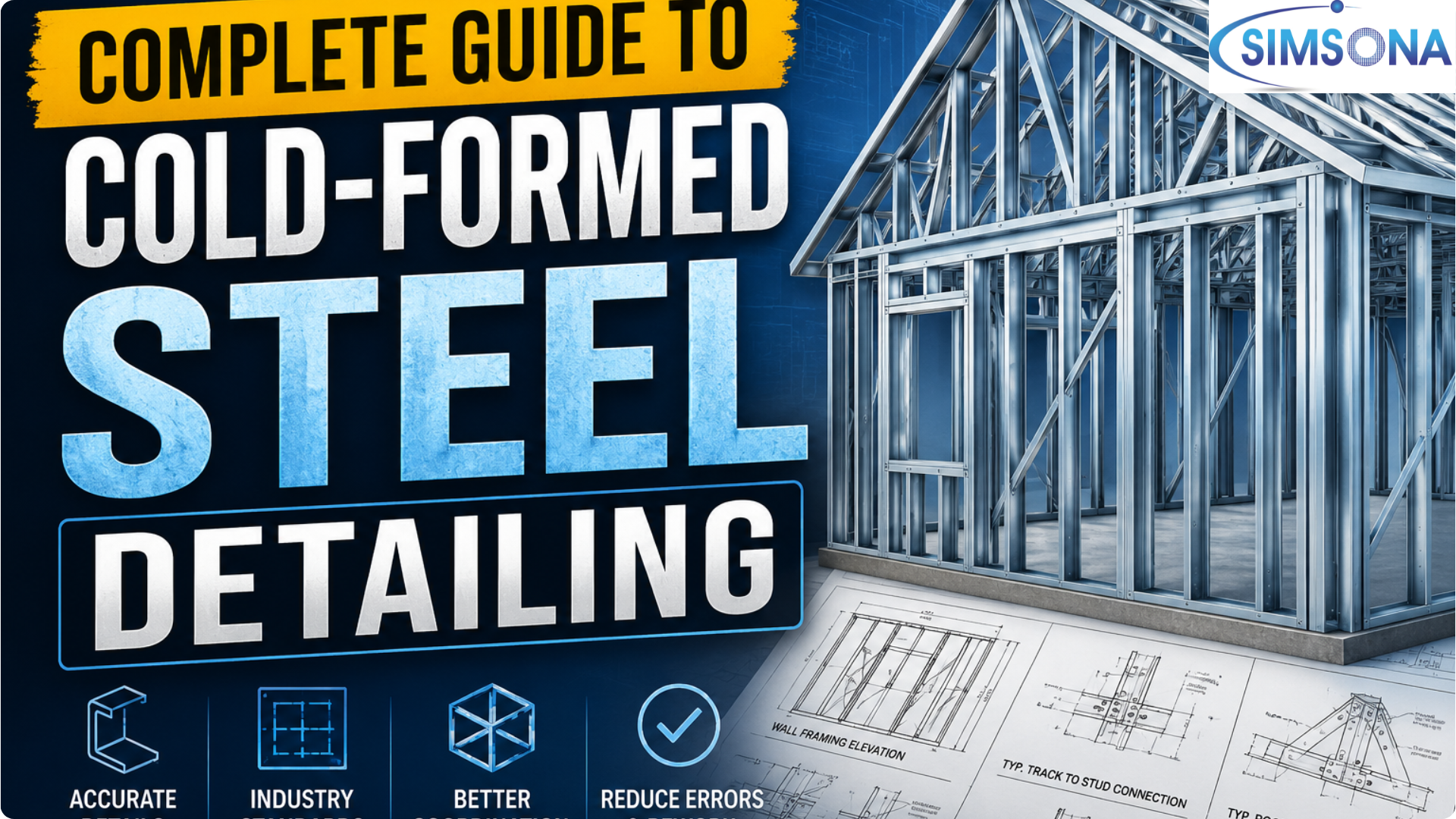
Modern construction is changing rapidly. Builders today want structures that are faster to construct, cost-effective, durable, lightweight, and environmentally friendly. Because of these requirements, cold-formed steel has become one of the most preferred materials in residential, commercial, industrial, and modular construction projects. However, simply using cold-formed steel is not enough to ensure a successful project. The real efficiency of the system depends heavily on accurate detailing.
Cold-formed steel detailing is the backbone of fabrication and installation. It transforms engineering concepts into practical drawings and precise instructions that fabricators and contractors can follow without confusion. From wall studs and floor joists to roof trusses and panelized systems, every cold-formed steel component must be carefully detailed to avoid errors during manufacturing and construction.
What Is Cold-Formed Steel?
Cold-formed steel, often abbreviated as CFS, is a lightweight structural material made by shaping thin steel sheets into different profiles at room temperature. Unlike traditional hot-rolled steel, which is formed under high heat, cold-formed steel is manufactured using rolling, bending, and pressing techniques without heating the material.
The process gives the steel high strength while keeping it lightweight. This unique combination makes cold-formed steel ideal for modern construction projects where speed, precision, and efficiency are important.
Cold-formed steel sections are available in many shapes, including:
- C-sections
- U-channels
- Z-sections
- Hat channels
- Studs
- Tracks
- Sigma sections
These sections are widely used in:
- Wall framing
- Roof trusses
- Floor systems
- Interior partitions
- Modular buildings
- Industrial sheds
- Panelized structures
One of the biggest advantages of cold-formed steel is that it can be prefabricated with high precision, which significantly reduces onsite construction time.
What Is Cold-Formed Steel Detailing?
Cold-formed steel detailing is the process of creating detailed technical drawings and digital models that guide the fabrication and installation of cold-formed steel components.
In simple words, detailing converts engineering designs into practical instructions for manufacturers and construction teams.
A detailer prepares accurate drawings showing:
- Sizes of steel members
- Dimensions
- Hole locations
- Fastener positions
- Connection details
- Assembly methods
- Panel layouts
- Material specifications
Without detailing, fabricators would not know how to manufacture the steel members correctly, and installation teams would struggle to assemble the structure properly onsite.
Cold-formed steel detailing acts as a bridge between structural design and actual construction.
Why Cold-Formed Steel Detailing Is Important
Many people underestimate the importance of detailing in construction projects. In reality, detailing is one of the most critical stages because it directly affects fabrication accuracy, construction speed, structural safety, and project cost.
Ensures Fabrication Accuracy
Cold-formed steel systems contain hundreds or even thousands of lightweight members. Even a small mistake in dimensions or hole placements can create major installation problems.
Accurate detailing ensures that every component is manufactured exactly according to design requirements.
Reduces Construction Delays
Proper detailing helps eliminate confusion during installation. Workers can assemble components quickly because every part is clearly labeled and dimensioned.
This significantly reduces delays and improves project schedules.
Supports Prefabrication
Cold-formed steel construction heavily relies on prefabrication. Wall panels, roof trusses, and floor systems are often manufactured in factories before being transported to the site.
Detailed shop drawings are essential for successful prefabrication.
Minimizes Material Waste
Efficient detailing optimizes member lengths and layouts, reducing unnecessary material usage. This helps contractors save money and reduce construction waste.
Improves Coordination
Construction projects involve multiple disciplines such as architecture, structural engineering, plumbing, electrical systems, and HVAC systems.Cold-formed steel detailers coordinate with all these disciplines to avoid clashes and installation conflicts.
Enhances Structural Safety
Poor detailing can weaken structural performance. Proper detailing ensures that all members, braces, and connections can safely transfer loads throughout the structure. This is especially important in areas exposed to earthquakes, heavy winds, or extreme weather conditions.
Main Components of Cold-Formed Steel Detailing
Cold-formed steel detailing involves several important drawing types and documentation packages.
Shop Drawings
Shop drawings are detailed fabrication drawings used directly by manufacturers.
These drawings contain:
- Member dimensions
- Steel thickness
- Hole patterns
- Fastener spacing
- Material grades
- Part labels
- Cutting details
Fabricators use shop drawings to manufacture each component accurately.
For example, if a wall stud requires service holes for electrical conduits, the exact size and location of those holes will be specified in the shop drawing.
Panel Drawings
Panel drawings illustrate complete assemblies such as wall panels, floor panels, and roof trusses.
These drawings show:
- Stud spacing
- Bracing systems
- Openings for windows and doors
- Connection points
- Structural reinforcements
Panel drawings are especially important in modular and prefabricated construction.
Erection Drawings
Erection drawings guide onsite installation teams.
They explain:
- Component locations
- Assembly sequences
- Installation methods
- Alignment requirements
- Structural positioning
Without erection drawings, onsite construction can become slow and confusing.
Connection Details
Connections are one of the most important aspects of cold-formed steel structures because thin steel members depend heavily on fastening systems.
Connection detailing includes:
- Screws
- Bolts
- Welds
- Clips
- Anchors
- Brackets
The detailer ensures that connections are strong enough to handle structural loads safely.
Bill of Materials (BOM)
The Bill of Materials lists every component required for fabrication and construction.
It includes:
- Member quantities
- Section sizes
- Material types
- Fasteners
- Accessories
- Weights
The BOM helps contractors estimate costs and manage material procurement efficiently.
Step-by-Step Cold-Formed Steel Detailing Process
Cold-formed steel detailing follows a structured workflow.
- Reviewing Design Documents
The detailing process begins with studying project documents carefully.
These include:
- Architectural drawings
- Structural drawings
- Engineering calculations
- Design specifications
- Building codes
The detailer must understand the structural system completely before beginning the modeling work.
- Creating 3D BIM Models
Modern detailing companies use BIM (Building Information Modeling) software to create intelligent 3D models.
The model includes:
- Steel framing
- Bracing systems
- Openings
- Connections
- Roof framing
- Floor framing
3D modeling helps identify clashes before fabrication begins.
For example, a duct passing through a structural stud can be detected early and corrected digitally instead of onsite.
- Preparing Detailed Drawings
After the 3D model is finalized, the detailer generates detailed shop and erection drawings.
These drawings include precise information required for fabrication and installation.
Every member receives a unique mark number for easy identification.
- Coordination With Other Trades
Cold-formed steel framing interacts with multiple building systems.
The detailer coordinates with:
- HVAC teams
- Plumbing engineers
- Electrical consultants
- Fire protection systems
- Architectural teams
This coordination prevents costly clashes during construction.
- Fabrication Support
After approval, fabrication begins in the factory.
Detailers often continue supporting fabricators by:
- Clarifying drawing questions
- Updating revisions
- Resolving RFIs
- Modifying details when necessary
Software Used in Cold-Formed Steel Detailing
Technology has completely transformed cold-formed steel detailing.
Several advanced software solutions are widely used in the industry.
Tekla Structures
Tekla Structures is one of the most powerful steel detailing software platforms.
It allows detailers to create highly accurate 3D models and automated shop drawings.
Key features include:
- Advanced BIM modeling
- Automated reports
- Clash detection
- CNC integration
- Fabrication support
Autodesk Revit
Revit is commonly used for BIM coordination and architectural integration.
It supports collaboration between architects, engineers, and contractors.
Vertex BD
Vertex BD specializes in panelized and modular framing systems.
It is widely used in residential construction projects.
FRAMECAD
FRAMECAD offers integrated solutions for design, detailing, and automated manufacturing.
It supports direct machine integration for efficient fabrication.
Challenges in Cold-Formed Steel Detailing
Despite its advantages, cold-formed steel detailing has certain challenges.
Complex Structural Connections
Because the steel sections are thin, connections require careful engineering and detailing.
Improper fastening can weaken the structure.
Frequent Design Changes
Construction projects often experience revisions during execution.
Updating models and drawings repeatedly can be time-consuming.
Coordination Problems
Poor coordination with MEP systems can create major installation issues onsite.
Precision Requirements
Cold-formed steel systems require extremely accurate dimensions.
Even small errors can affect panel alignment and structural performance.
Role of BIM in Cold-Formed Steel Detailing
BIM has revolutionized cold-formed steel detailing.
Instead of relying only on 2D drawings, BIM creates intelligent digital models containing complete project information.
Benefits of BIM include:
- Better visualization
- Improved coordination
- Clash detection
- Faster drawing generation
- Accurate quantity takeoffs
- Enhanced collaboration
BIM also supports modular and prefabricated construction workflows.
Applications of Cold-Formed Steel Detailing
Cold-formed steel detailing is used in many construction sectors.
Residential Construction
Cold-formed steel is widely used in:
- Villas
- Apartments
- Modular homes
- Residential towers
Commercial Buildings
Applications include:
- Offices
- Hotels
- Retail centers
- Schools
Industrial Structures
Cold-formed steel systems are used in:
- Warehouses
- Factories
- Storage facilities
- Industrial platforms
Modular Construction
Modular construction heavily depends on accurate detailing because components are manufactured offsite.
Future of Cold-Formed Steel Detailing
The future of cold-formed steel detailing is closely connected with digital construction technologies.
Emerging trends include:
- AI-assisted detailing
- Cloud-based BIM collaboration
- Robotics
- Automated fabrication
- Parametric modeling
- Digital twins
As construction companies continue adopting modular and prefabricated methods, demand for skilled cold-formed steel detailers will continue growing.
Conclusion
Cold-formed steel detailing is much more than creating technical drawings. It is a critical process that connects engineering design, fabrication, and construction. Accurate detailing improves project quality, reduces errors, speeds up installation, and ensures structural safety.
From BIM modeling and shop drawings to coordination and fabrication support, every stage of detailing contributes to successful project execution. As modern construction moves toward automation, prefabrication, and sustainable building methods, cold-formed steel detailing will become even more important in the future.
For engineers, contractors, architects, fabricators, and construction companies, understanding cold-formed steel detailing is essential for delivering efficient, accurate, and high-quality building projects.
FAQs
What is the purpose of cold-formed steel detailing?
Cold-formed steel detailing provides fabrication and installation drawings that help manufacturers and contractors build structures accurately and efficiently.
What is the difference between hot-rolled steel and cold-formed steel?
Hot-rolled steel is shaped at high temperatures, while cold-formed steel is shaped at room temperature using thin steel sheets.
Why is BIM important in cold-formed steel detailing?
BIM improves coordination, clash detection, visualization, and fabrication accuracy while reducing errors and construction delays.
Which software is best for cold-formed steel detailing?
Popular software includes Tekla Structures, Autodesk Revit, Vertex BD, and FRAMECAD.
What are the benefits of cold-formed steel construction?
Cold-formed steel offers lightweight construction, faster installation, high strength, recyclability, fire resistance, and dimensional accuracy.

Send Us
drawings and scope
Click the Dropbox link and send us your complete scope and drawings.
We will provide estimate in 24 to 48 hours.


